Evaluation and Optimization: IoU, Non-max Suppression, Anchor Boxes
Intersection over Union (IoU)
Intersection over Union (IoU) is a metric used to evaluate the accuracy of an object detector on a particular dataset. It measures the overlap between two bounding boxes:
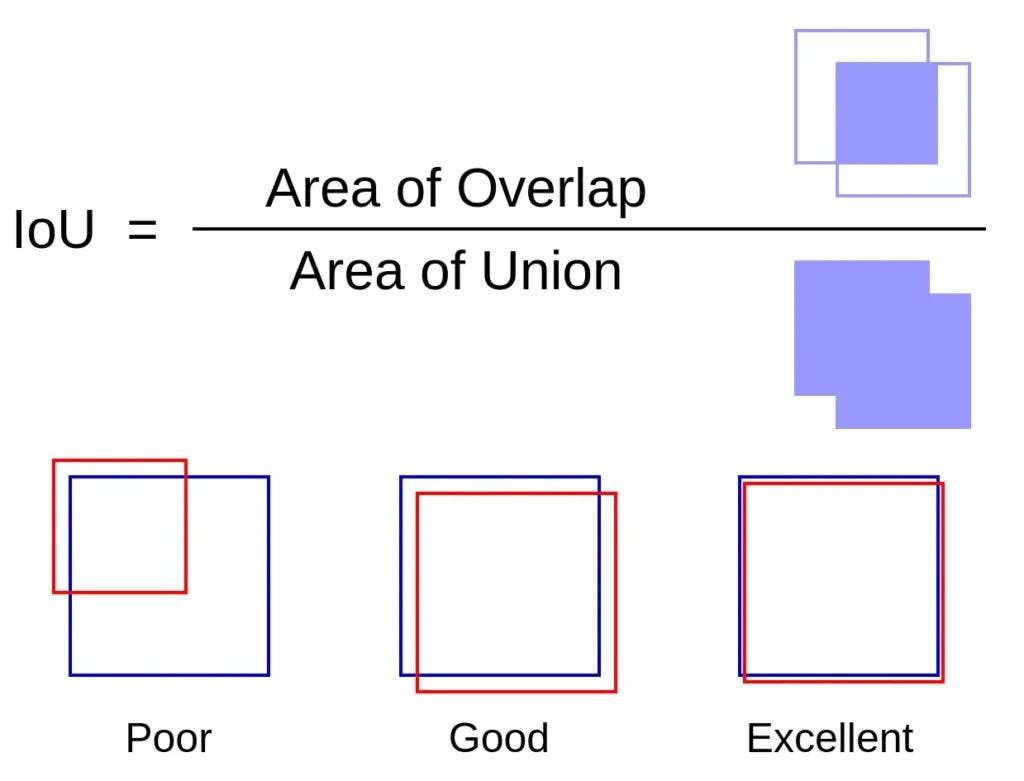
- The predicted bounding box
- The ground-truth bounding box
Mathematical Definition
If $B_p$ is the predicted bounding box and $B_{gt}$ is the ground truth bounding box:
$$ IoU = \frac{Area(B_p \cap B_{gt})}{Area(B_p \cup B_{gt})} $$
- $IoU = 1.0$: perfect overlap
- $IoU = 0.0$: no overlap
Example
Suppose:
- Predicted box: top-left = (50, 50), bottom-right = (150, 150)
- Ground truth: top-left = (100, 100), bottom-right = (200, 200)
The overlapping area is a square from (100, 100) to (150, 150) → 50x50 = 2500
Total area:
- Predicted: $100 \times 100 = 10,000$
- GT: $100 \times 100 = 10,000$
- Union: $10,000 + 10,000 - 2,500 = 17,500$
So,
$$ IoU = \frac{2500}{17500} = 0.143 $$
Use in Training and Evaluation
- In training, you may ignore detections with IoU < 0.5
- For evaluation, mAP (mean average precision) uses IoU thresholds (e.g., 0.5 or 0.75)
Non-max Suppression (NMS)
Why Do We Need It?
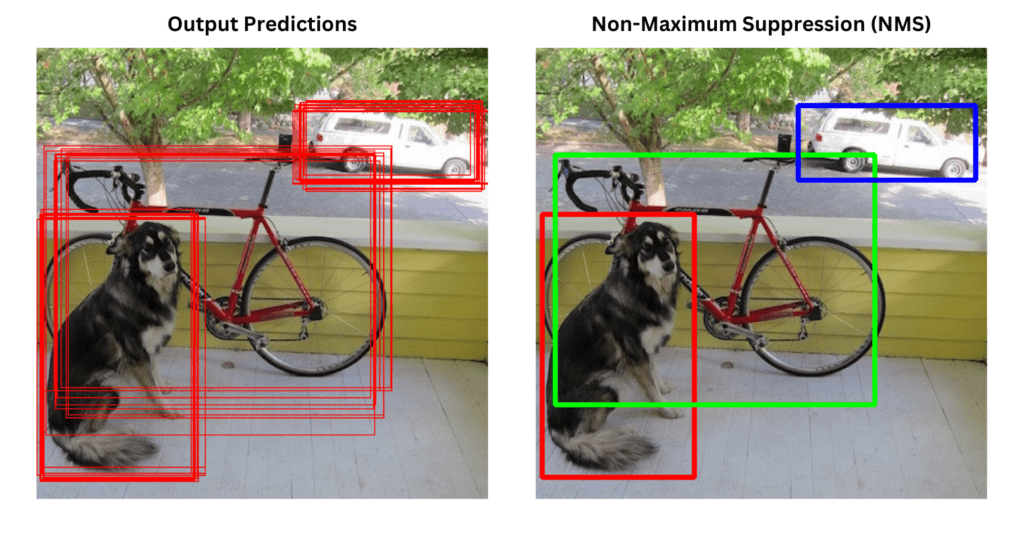
Object detectors often output multiple overlapping boxes for a single object. NMS filters out redundant boxes by keeping the one with the highest confidence score.
Algorithm Steps
- Sort all bounding boxes by their confidence score.
- Select the box with the highest confidence and remove it from the list.
- Compute IoU between this box and all others.
- Remove boxes with IoU above a threshold (e.g., 0.5).
- Repeat until no boxes remain.
Mathematical Intuition
Let $B_i$ be a box with score $s_i$. You iterate over all boxes and apply:
$$ \text{Keep } B_i \text{ if } IoU(B_i, B_j) < T, \forall j < i $$
Where $T$ is the suppression threshold.
Anchor Boxes
What are Anchor Boxes?
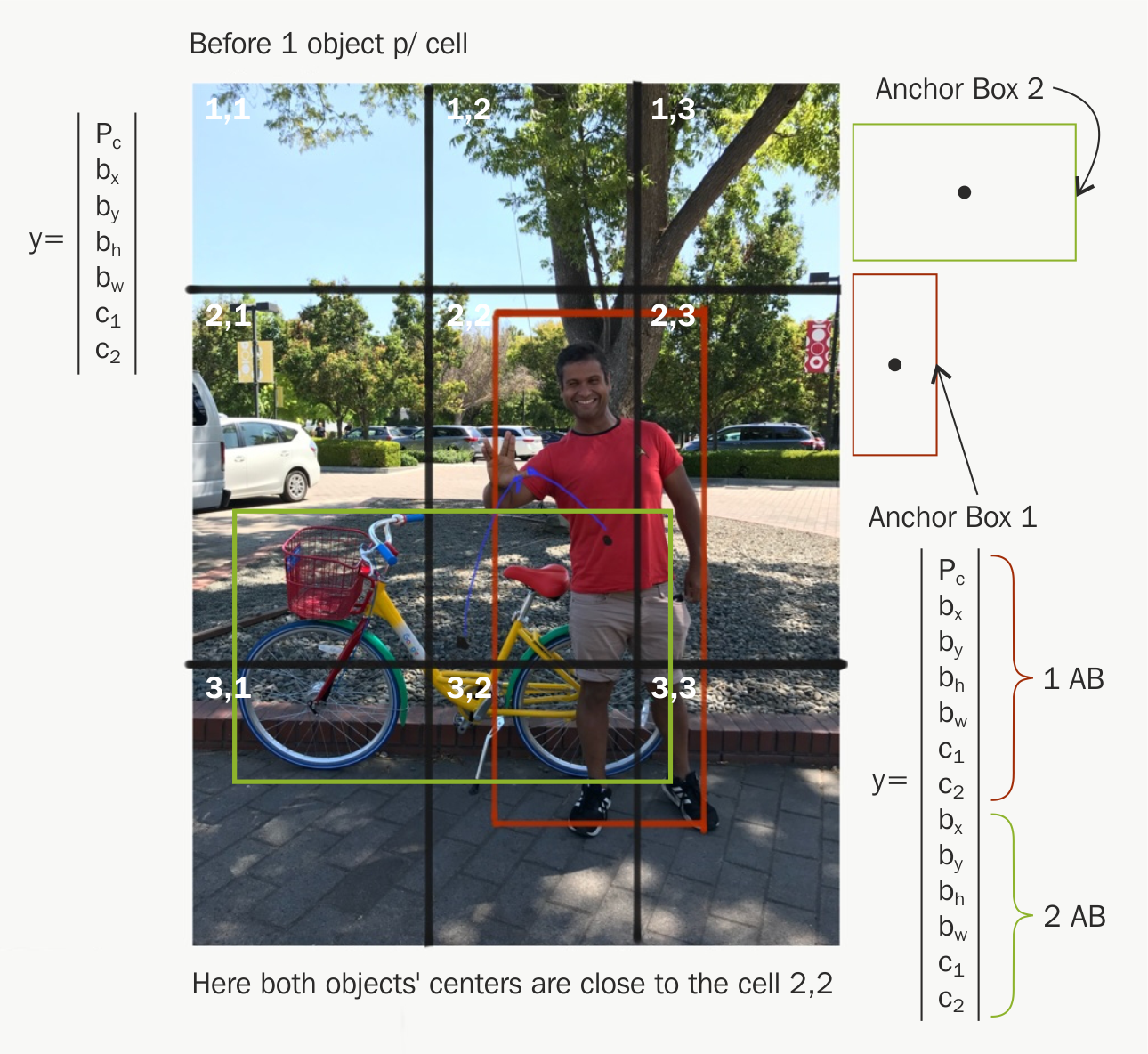
Anchor boxes (also called prior boxes) are predefined bounding boxes with different shapes and sizes. They allow object detectors to:
- Detect multiple objects in the same grid cell
- Handle aspect ratio and scale variation
Why Are They Needed?
Without anchor boxes, a single grid cell could detect only one object. But real-world scenes often contain overlapping or closely spaced objects.
Anchor Box Design
You predefine $k$ anchor boxes per cell. Each one is defined by:
- Width $w$
- Height $h$
- Aspect ratio $r = \frac{w}{h}$
For example, in SSD:
- 3 feature maps
- 6 anchors per feature cell
- $\Rightarrow$ 8732 total anchor boxes
Output Format with Anchors
For each anchor box, the network predicts:
- $\Delta x, \Delta y$: offset from anchor center
- $\Delta w, \Delta h$: log scale changes to width and height
- Confidence score
- Class probabilities
This transforms anchor box $(x_a, y_a, w_a, h_a)$ to the predicted box $(x_p, y_p, w_p, h_p)$:
$$ x_p = x_a + w_a \cdot \Delta x \ y_p = y_a + h_a \cdot \Delta y \ w_p = w_a \cdot e^{\Delta w} \ h_p = h_a \cdot e^{\Delta h} $$
Summary
- IoU measures overlap and is used for loss/evaluation.
- Non-max suppression removes redundant boxes based on IoU.
- Anchor boxes allow detection of multiple objects at different scales/aspect ratios.
Together, these techniques form the foundation of modern object detection pipelines like YOLO, SSD, and Faster R-CNN.