Face Recognition and Neural Style Transfer
What is Face Recognition?
Face recognition is the task of identifying or verifying a person’s identity using their facial features. It can be broken down into three main categories:
- Face Detection: Locate faces in an image (bounding box).
- Face Verification: Check if two faces are of the same person (1:1 comparison).
- Face Recognition/Identification: Identify a person from a database (1:N comparison).
Real-World Applications
- Smartphone unlock (Face ID)
- Security surveillance
- Online proctoring
- Social media tagging (e.g., Facebook)
One Shot Learning
Traditional classification algorithms require many training examples per class. However, in face recognition:
- We might only have one image per person.
- The task becomes: Can the model recognize a face it has seen only once?
This is known as One-Shot Learning.
Problem Setup
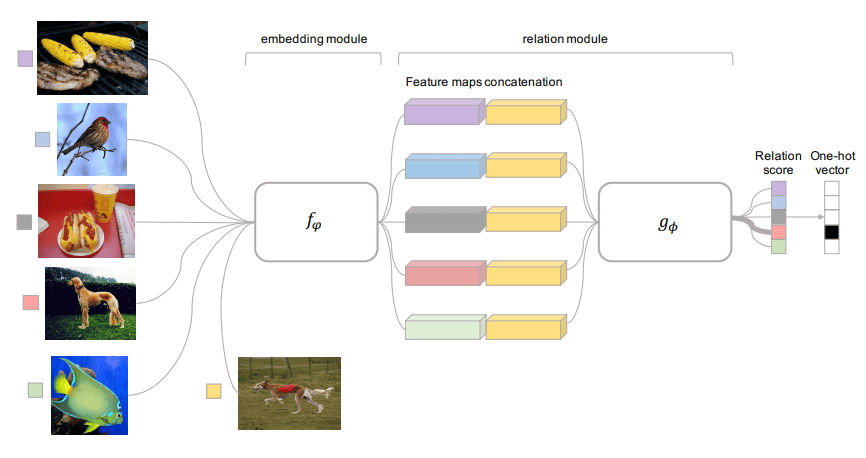
- Instead of learning to classify, the model learns similarity between pairs of images.
- A distance function is trained to return a small value for the same person, and large for different people.
Siamese Network
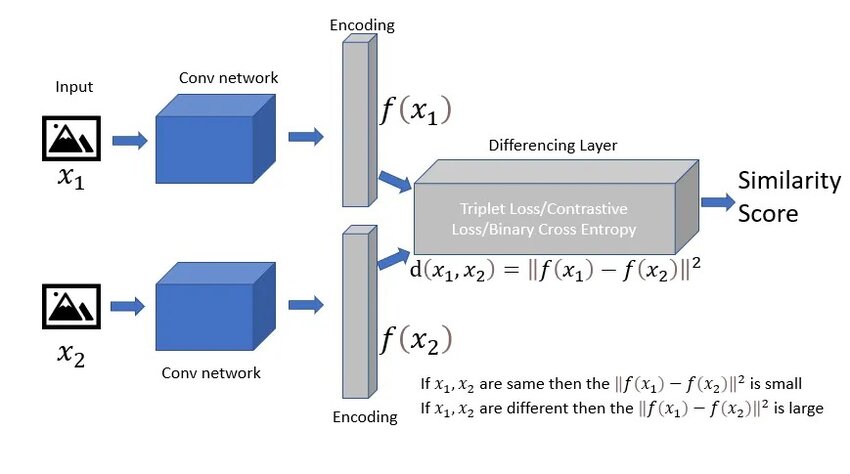
A Siamese Network consists of two identical ConvNets (with shared weights) that compare two inputs.
Architecture Overview
- Two inputs: $x_1$ and $x_2$
- Same CNN maps both to feature vectors $f(x_1)$ and $f(x_2)$
- A distance metric (e.g., L2 norm) is applied:
$$ d(x_1, x_2) = |f(x_1) - f(x_2)|_2^2 $$
Loss Function
A contrastive loss or triplet loss is used to train the network to minimize distances for same identities and maximize for different ones.
Triplet Loss
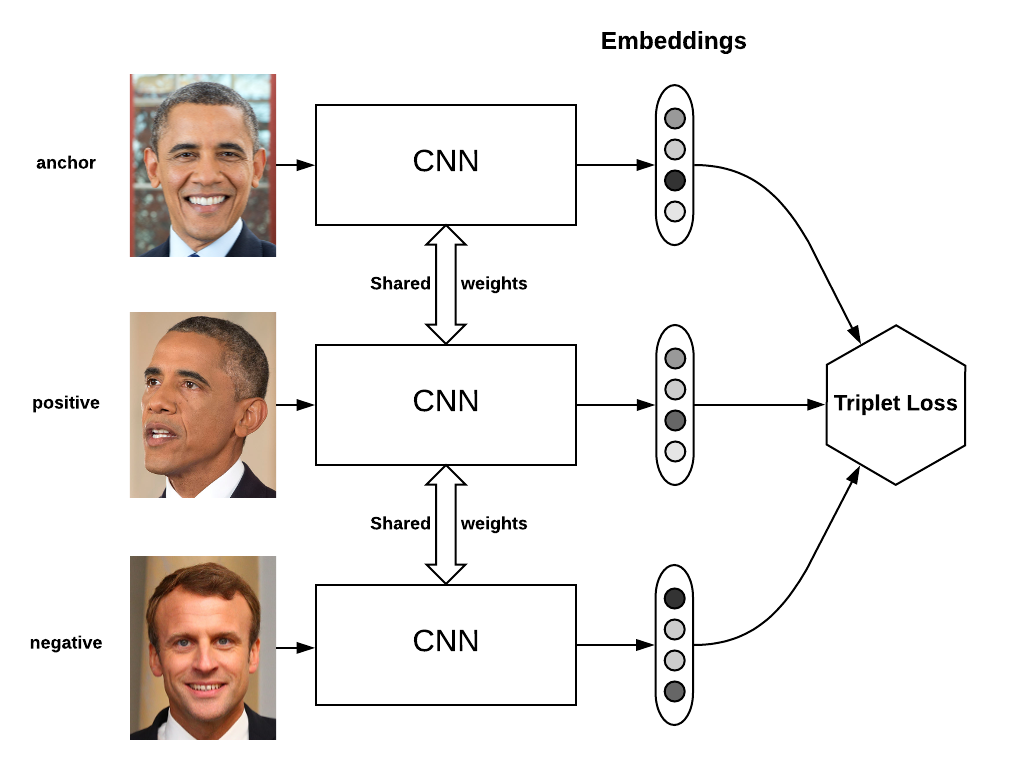
Triplet Loss is a powerful loss function for learning embeddings. It relies on triplets:
- Anchor (A): A known image
- Positive (P): Image of the same identity
- Negative (N): Image of a different identity
We want:
$$ |f(A) - f(P)|_2^2 + \alpha < |f(A) - f(N)|_2^2 $$
Where:
- $f(x)$ is the embedding function (ConvNet output)
- $\alpha$ is a margin to separate positive and negative pairs
Loss Function
The Triplet Loss is:
$$ \mathcal{L}(A, P, N) = \max\left(|f(A) - f(P)|_2^2 - |f(A) - f(N)|_2^2 + \alpha, 0\right) $$
Important Notes
- Semi-hard negative mining improves convergence (choose negatives that are hard but not too hard).
- Embeddings are often normalized to unit length.
Face Verification and Binary Classification
Once we have embeddings from a trained network (e.g., using triplet loss), we can perform face verification as a binary classification task.
Verification Pipeline
- Encode both face images to embeddings.
- Compute Euclidean distance or cosine similarity.
- If distance < threshold $\Rightarrow$ same person.
Threshold $\theta$ is selected based on False Positive Rate vs. True Positive Rate using ROC curve on a validation set.
What is Neural Style Transfer?
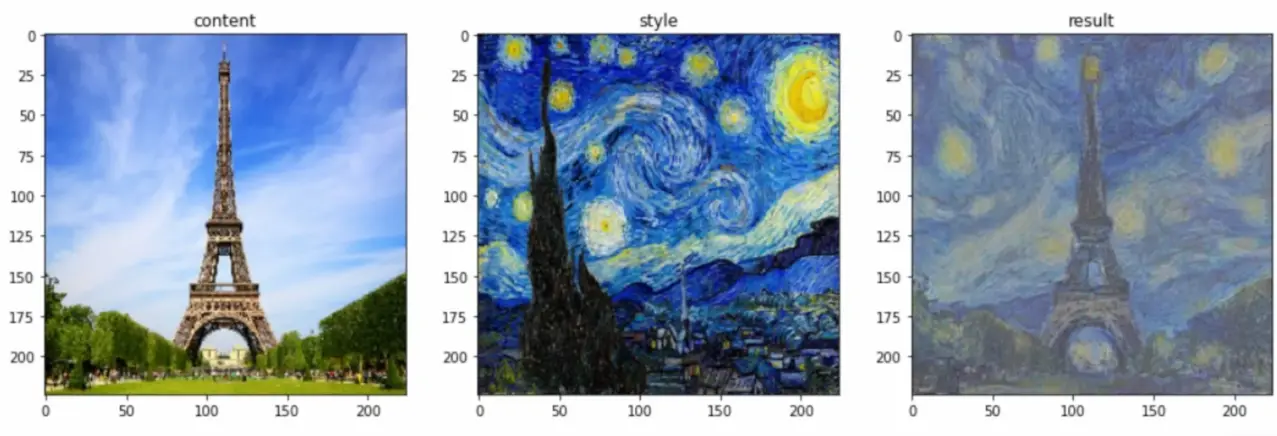
Neural Style Transfer is the task of synthesizing an image that:
- Preserves the content of a content image
- Adopts the style of a style image
Leverage a pre-trained ConvNet (like VGG19) to extract content and style representations.
Let:
- $C$ be the content image
- $S$ be the style image
- $G$ be the generated image
Then we optimize $G$ to minimize a cost function:
$$ J(G) = \alpha J_{content}(C, G) + \beta J_{style}(S, G) $$
What are Deep ConvNets Learning?
Deep ConvNets learn hierarchical representations:

- Early layers: edges, colors, textures
- Mid layers: shapes, motifs
- Later layers: object-level concepts
In NST, content is encoded in deeper layers, style in shallower layers.
Cost Function
The total cost is:
$$ J(G) = \alpha J_{content}(C, G) + \beta J_{style}(S, G) $$
Where:
- $\alpha$: weight for content preservation
- $\beta$: weight for style transfer
- Typically: $\alpha = 1$, $\beta = 10^3$ to $10^4$
Content Cost Function
Let $a^{l}$ and $a^{l}$ be activations at layer $l$ for the content and generated images.
Then content cost is:
$$ J_{content}(C, G) = \frac{1}{2} |a^{l} - a^{l}|_2^2 $$
Use a deeper layer (e.g., conv4_2) for this.
Style Cost Function
Style is captured by correlations between feature maps using a Gram matrix.
Let $a^{l}$ be the activations at layer $l$ for style image. Compute Gram matrix:
$$ G_{ij}^{[l]} = \sum_k a_{ik}^{[l]} a_{jk}^{[l]} $$
Style cost is:
$$ J_{style}^{[l]}(S, G) = \frac{1}{(2n_H n_W n_C)^2} |G^{l} - G^{l}|_F^2 $$
Then sum over multiple layers:
$$ J_{style}(S, G) = \sum_l \lambda^{[l]} J_{style}^{[l]}(S, G) $$
1D and 3D Generalizations
1D Generalization
Neural style transfer principles can be applied to audio signals:
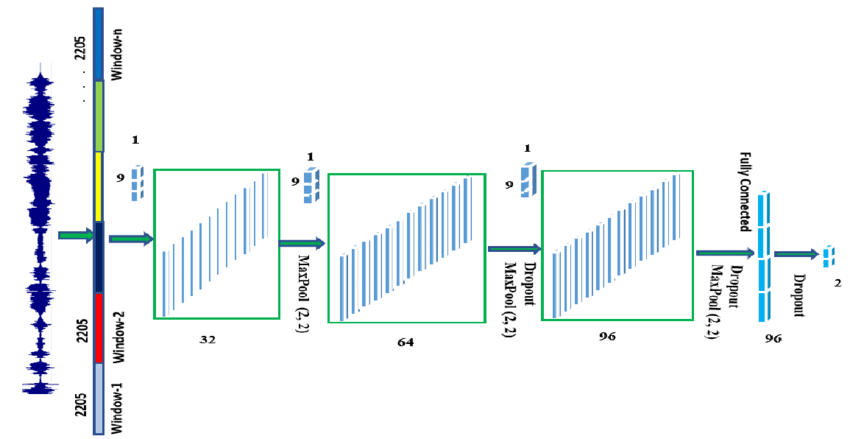
- 1D convolution over waveform
- Preserve temporal content, apply style of another sound
3D Generalization
Applied to volumetric data such as:
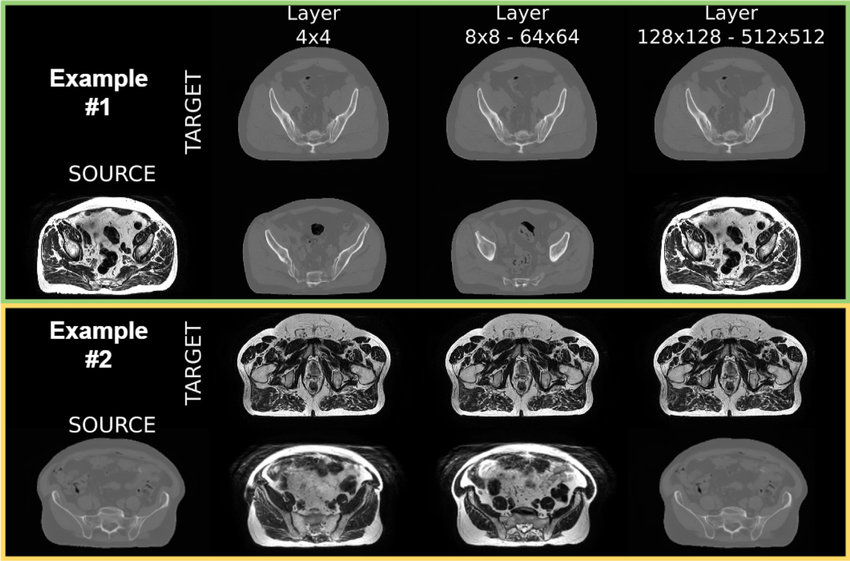
- 3D MRI scans
- 3D point clouds
- Transfer spatial styles across 3D volumes
These require 3D convolutional layers and custom Gram matrix calculations.
Summary
- Face Recognition uses embedding learning (Triplet loss, Siamese networks).
- One-shot learning enables models to generalize with limited data.
- Neural Style Transfer uses a pre-trained CNN to blend content and style images using a combination of content/style loss.
- Both applications showcase the expressive power of deep convolutional networks beyond classic classification.