Introduction to Computer Vision
- 1. What is Computer Vision?
- 2. The Human Visual System: Biology, Fallibility, and Ambiguity
- 3. Topics Covered: Roadmap
- 4. Global Applications: Computer Vision in the Modern World
1. What is Computer Vision?
Computer vision is not merely a subset of artificial intelligence; it is a profound multidisciplinary engineering and scientific enterprise. It bridges the physical world and symbolic understanding, drawing upon optics, signal processing, electrical engineering, and computer science.
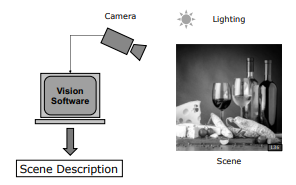
Vision pipeline: light source → scene → camera → Vision Software produces a scene description
The fundamental challenge lies in transforming raw numerical arrays—pixel data—into a meaningful description of the 3D environment.

Raw visual input: two children showering
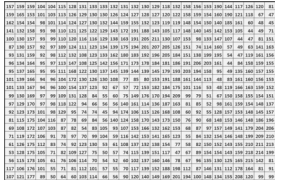
Same scene as a numerical pixel matrix
In this field, the definition of the mission often dictates the methodology. Below is a comparison of the three primary philosophical pillars of computer vision research:
| Perspective | Proponent | Core Philosophy |
|---|---|---|
| Vision as Emulation | David Marr | Aimed at automating human visual processes to replicate the sophistication of biological systems |
| Vision as Information Processing | Berthold Horn | Defined as the task of “inverting” image formation—mathematically walking back from a 2D projection to 3D reality |
| Vision as a Functional Tool | Takeo Kanade | Emphasizes that vision is “fun” but, more importantly, “useful,” serving as a bridge between pure research and practical application |
1.1 The “First Principles” Philosophy
While contemporary deep learning provides powerful tools, a First Principles approach—focusing on mathematical and physical underpinnings—is the prerequisite for generalizable and explainable AI. Relying on “black box” models often bypasses the structural understanding required for true innovation.
Why First Principles? Physical phenomena can be described with elegant math, making massive datasets and exhaustive training cycles unnecessary.
We prioritize these fundamentals for four reasons:
- Precision and Conciseness — Physical phenomena can often be described with elegant math, rendering massive datasets unnecessary.
- Debugging and Diagnostics — When a vision system fails, first principles provide the only rigorous framework for diagnosing the failure.
- Synthetic Data Generation — When real-world data collection is impractical or dangerous, mathematical models allow us to synthesize high-fidelity training data.
- Scientific Curiosity — The innate human drive to understand the “why” behind visual phenomena leads to breakthroughs that purely data-driven methods overlook.
2. The Human Visual System: Biology, Fallibility, and Ambiguity
Studying the human eye is a necessary starting point for designing artificial vision. Even though machines and humans often have divergent goals—qualitative navigation versus quantitative measurement—the eye provides a blueprint for efficient information reduction.
2.1 The Biological Pathway
The human visual system is a complex hierarchy designed for rapid analysis:
flowchart LR
    A["👁️ Eye & Lens<br/><i>Primary optical stage</i>"] --> B["🧬 Retina<br/><i>Early processing + data reduction</i>"]
    B --> C["🔌 Optic Nerve<br/><i>High-speed conduit</i>"]
    C --> D["🧠 LGN<br/><i>Relay station, directs to regions</i>"]
    D --> E["🎯 Visual Cortex<br/><i>Shape, color, motion, texture</i>"]

    style A fill:#1a1a2e,stroke:#e94560,color:#fff
    style B fill:#16213e,stroke:#e94560,color:#fff
    style C fill:#0f3460,stroke:#e94560,color:#fff
    style D fill:#1a1a2e,stroke:#e94560,color:#fff
    style E fill:#16213e,stroke:#e94560,color:#fff
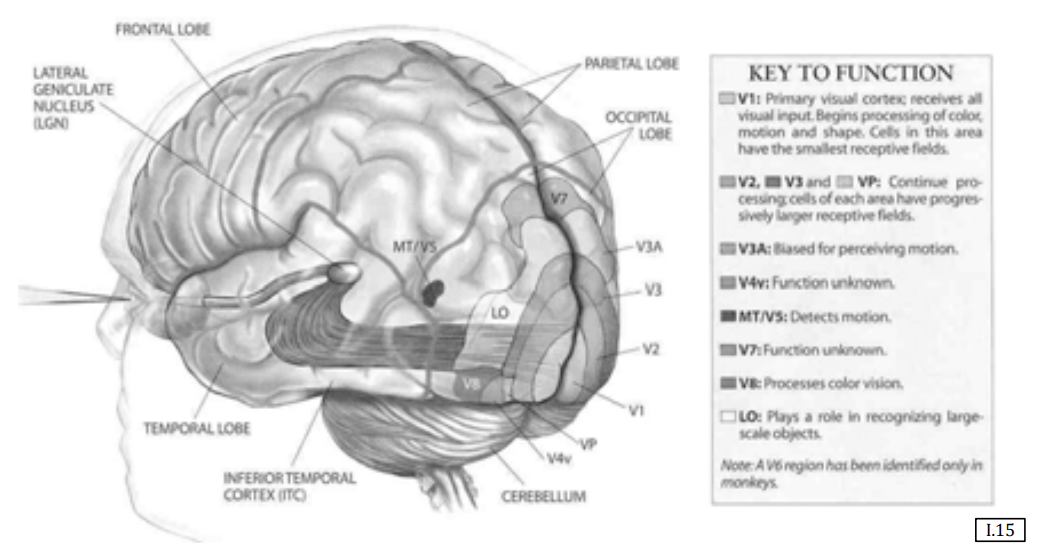
Biological vision pathway: retina → LGN → visual cortex (V1, V2, MT/V5, V8)
2.2 Qualitative vs. Quantitative Vision
As engineers, we must recognize that human vision is a qualitative system, whereas factory automation, medical imaging, and robotics require quantitative precision. A human can recognize a face instantly but cannot measure the length of a component to the nearest millimeter. For tasks requiring extreme reliability, emulating human biology is often the “wrong” goal; machines must provide the measurable accuracy that biological systems lack.
2.3 Case Studies in Visual Illusions
Human vision is more fallible than it appears, often relying on internal assumptions to resolve ambiguity.
Example — Dongary Wave Illusion: The static leaf pattern below appears to shimmer or move due to involuntary micro-saccades of the eye.
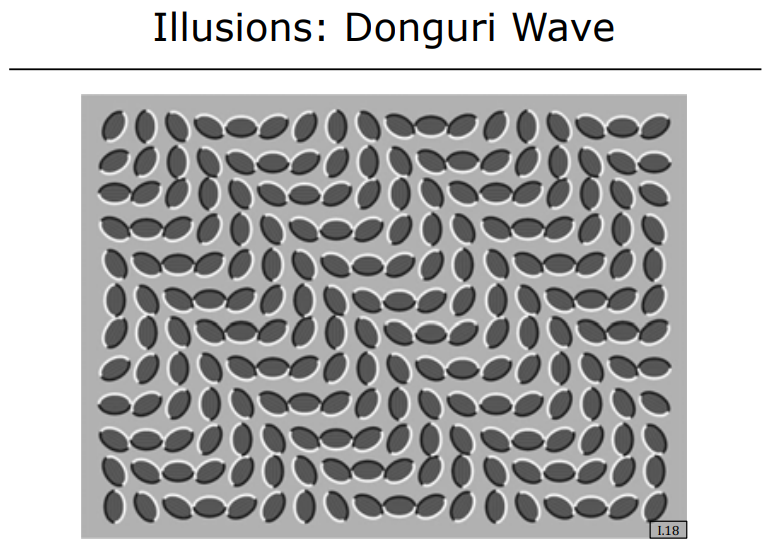
Static leaf pattern that produces a perception of motion — the Dongary Wave illusion
| Illusion | What It Reveals |
|---|---|
| Fraser’s Spiral | Concentric circles misinterpreted as a spiral |
| Adelson’s Checker Shadow | Brain compensates for illumination — two identical gray patches look different |
| Dongary Wave | Perceived motion from a static image due to involuntary eye movements |
| Ames Room | Perspective and relative size create an illusion where people appear to grow or shrink |
| Necker Cube / Faces vs. Vase | A single 2D image supports multiple 3D or symbolic interpretations |
| The Crater Illusion | The “lighting from above” assumption — flipping a mound makes it appear as a crater |
| Kanizsa Triangle | The brain “fills in” data (thinking) rather than just processing pixels (seeing) |
Key Insight: While humans think through their visual experiences, machines must first learn to calculate through the rigorous lens of radiometry and geometry.
3. Topics Covered: Roadmap
This specialization covers the entire pipeline — from pixels to perception — organized into six modules:
flowchart TB
    subgraph Foundations["🟦 Foundations"]
        direction TB
        A["Introduction<br/><i>What is CV, human vision</i>"]
        B["Imaging<br/><i>Formation, sensors, processing</i>"]
    end

    subgraph Features["🟧 Features & 2D"]
        C["Features<br/><i>Edges, SIFT, stitching, faces</i>"]
    end

    subgraph Reconstruction["🟩 3D Reconstruction"]
        D["Reconstruction I<br/><i>Radiometry, photometric stereo</i>"]
        E["Reconstruction II<br/><i>Stereo, optical flow, SfM</i>"]
    end

    subgraph Perception["🟥 Perception"]
        F["Perception<br/><i>Tracking, segmentation, NN</i>"]
    end

    A --> B --> C --> D --> E --> F

    style A fill:#1a1a2e,stroke:#4cc9f0,color:#fff
    style B fill:#1a1a2e,stroke:#4cc9f0,color:#fff
    style C fill:#1a1a2e,stroke:#f72585,color:#fff
    style D fill:#1a1a2e,stroke:#06d6a0,color:#fff
    style E fill:#1a1a2e,stroke:#06d6a0,color:#fff
    style F fill:#1a1a2e,stroke:#e94560,color:#fff
    style Foundations fill:transparent,stroke:#4cc9f0,color:#4cc9f0
    style Features fill:transparent,stroke:#f72585,color:#f72585
    style Reconstruction fill:transparent,stroke:#06d6a0,color:#06d6a0
    style Perception fill:transparent,stroke:#e94560,color:#e94560
Module Breakdown
| # | Module | Focus |
|---|---|---|
| 1 | Imaging | Image formation, sensors, binary images, image processing (convolution, Fourier) |
| 2 | Features | Edge/boundary detection, SIFT, image stitching, face detection |
| 3 | Reconstruction I | Radiometry, photometric stereo, shape from shading, depth from defocus |
| 4 | Reconstruction II | Camera calibration, stereo, optical flow, structure from motion |
| 5 | Perception | Object tracking, segmentation, appearance matching, neural networks |
4. Global Applications: Computer Vision in the Modern World
Vision has evolved from a laboratory curiosity into a thriving global industry across diverse sectors.
| Domain | Applications |
|---|---|
| Industrial / Efficiency | Factory automation, high-speed visual inspection, OCR for license plates and postal scanning |
| Security / Identity | Biometrics using iris patterns (as unique as DNA), robust face recognition |
| Consumer Tech | Optical mice (mini-vision systems), gaming (Kinect / PlayStation), AR (Snapchat 3D mesh filters) |
| Intelligent Marketing | Vending machines detecting customer demographics (age/gender) to display targeted products |
| Visual Search | Instant identification of monuments and objects via mobile devices |
| Advanced Mobility | Driverless cars using sensor fusion, Mars Rover terrain mapping |
| Creative / Medical | Motion capture for cinema, medical diagnostics (X-ray, MRI, ultrasound) |